
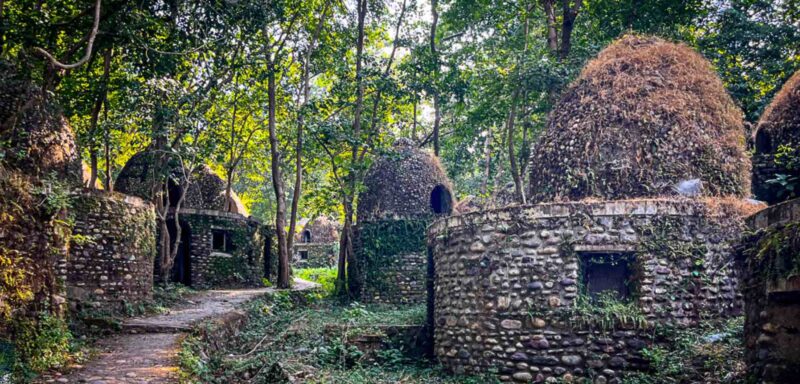
How to practice at Chaurasi Kutia
In 1968 it was not a traditional Indian ashram in the classical sense,
but rather an international meditation academy,
built largely for Westerners.
The course attended by the Beatles was attended by about 60–75 people from several countries.
A report published in February 1968
describes a three-month course with a progressive schedule, not a simple spiritual vacation.
The central element was, obviously, what the Maharishi called Transcendental Meditation:
The practitioner received a mantra/sound individually
and meditate with it.
The mantra was considered confidential between the teacher and the disciple.
Contemporary news reports describe the practice as directing attention to the sound of the mantra, not to its meaning.
The amount of practice could become surprisingly high.
Paul McCartney declared immediately after returning from India
that they had reached about five hours of meditation a day—about two in the morning and three in the evening.
Pattie Boyd even recounts a seven-hour personal session, from 5:00 p.m. to midnight.
This somewhat changes the modern commercial image of TM,
where the standard practice is much shorter.
The Rishikesh of 1968 was an intensive retreat.
What a day looked like
From independent reporting
of Pattie Boyd, Paul McCartney, Paul Saltzman, and the 1968 press
approximately the following structure results:
- early wake-up;
- light vegetarian breakfast;
- individual meditation in the room;
- meetings or practice checks with Maharishi;
- lectures on meditation and the development of consciousness;
- communal vegetarian meals;
- other long periods of meditation;
- conversations and questions with the Maharishi, often outdoors;
- in the evening, speeches and sometimes bhajan;
- among them: walks, rest, socializing and, in the case of the Beatles, a lot of musical composition.
Pattie Boyd describes the routine very simply: the days were similar to each other,
and the program consisted mainly of meditation and Maharishi’s lectures.
Sometimes the small group around the Beatles, Donovan, etc. received private lessons from him, in the open air.
Paul Saltzman confirms the atmosphere:
meditate, read, write, then meditate again;
the others spent important periods meditating,
and free time was very informal.
But what were the 84 kuṭī?
Something interesting appears here.
The name Chaurasi Kutia literally means approximately
“84 huts/cells”.
India’s official tourism website confirms the existence of
to the 84 meditation structures with the characteristic shape of a beehive/dome.
Some of the buildings we see today
did not yet exist in their current form during the Beatles’ stay in 1968.
For example, the Ved Bhavan and the pyramidal buildings Anand Bhavan/Siddhi Bhavan
are indicated as having been built later, around 1976,
the latter being used for the training of TM teachers.
A fascinating detail:
The Beatles had special “caves”
There is the testimony of a former collaborator of Maharishi,
Ravindra Damodara, according to which for the Beatles’ stay
four small stone constructions were built, with a dome,
each having a raised platform accessible with a ladder,
intended for more advanced meditation practices.
What was Maharishi aiming for through all this?
He does not seem to have pursued a firm focus on the mantra in the classical sense of dhāraṇā.
From TM’s explanations and participants’ accounts,
the method rather implied the use of sound as a vehicle for a progressive internalization,
until mental activity became more and more subtle.
In Maharishi’s own terminology,
The target was the “pure consciousness” or “transcendental consciousness” experience.
There is an important doctrinal difference here
Compared to some forms of mantra-yoga:
it was not the meaning of the mantra that was central but the inner sound of the Anahata type,
that is, what has to do with any spatial vibration.
Contemporary reporting in the Observer
explicitly says that the disciples had to fix their attention on the sound,
rather than its significance.
And there is a very interesting statement
attributed to Maharishi himself in that 1968 report:
he argued that, in the initial phase, the problem of faith in God
it wasn’t even necessary;
First the experience of consciousness had to be developed.
This says a lot about his project:
Maharishi was trying to present
A yogic method of access to transcendence that can be practiced by the West
even before the adoption of a Hindu metaphysics or religion.
And here I think is the most interesting part for you
If you look at the place from the perspective of a yoga school,
Chaurasi Kutia was an extraordinary experiment in “translation”
of Indian spirituality for the Western man.
Maharishi retains:
Guru → initiation → mantra → repeated practice → withdrawal → long periods of meditation → satsang/community lectures →→ vegetarian diet → bhajan → progressive intensification of the practice.
It eliminates or drastically reduces the need for
so that the practitioner knows the Vedānta beforehand,
Hindu ritual, Sanskrit, ascetic tapas or even to believe in God.
And that partly explains why the experiment
It had such a great cultural impact.
The Beatles didn’t just come to “learn to relax”.
They went into an intensive retreat for a few weeks
in which they sometimes meditated for hours every day.
Paul says about five hours a day;
Pattie Boyd describes a seven-hour meditation.
At the same time, the result was not a rigidly ascetic life.
They wrote music, talked, walked, sang, ate together.
It is precisely this combination
â— very intense inner practice + relatively natural and creative life –
seems to be one of the most interesting features of Maharishi’s experiment.
And there is one more important question:
what exactly did the Maharishi teach him after the practitioner passed the basic TM?
It’s about “advanced techniques”, teacher training and, later,
TM-Sidhi, and the connection with the Yoga Sutra
and with the tradition of Guru Dev (Swami Brahmananda Saraswati)
It becomes much more interesting.