
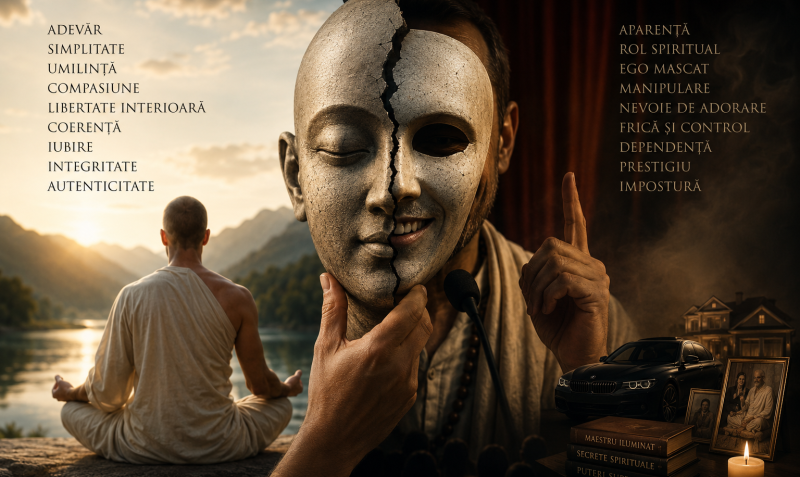

A little-known phenomenon:
the more you try to give the image that you know a lot or everything,
the more an inner phenomenon appears in which you already know less;
the more you think that you don’t know everything
at all and that you still have a lot to cover, the more your inner Path
opens up to you, tending to know more and more or, even,
to make the leap from the finite to the infinite.
If you can remember, in the movie The Matrix the hero goes to the Oracle,
who was actually a woman, and asks her if he is the Chosen One.
This tells him that he is full of qualities, but that he is not the Chosen One.
He accepts this and does not spare himself,
he uses all his strength, he takes risks, he helps his friends
and discovers that, in fact, he was the Chosen One.
Later he returns to the Oracle and asks her: why did you lie to me?
And she tells him that if he told him that he was the chosen One,
he would have spared himself, protected himself, he would not have given
himself and his potential to be the Chosen One would not have been revealed
.
In other words, it is indeed possible that your current level is good,
and your potential is extraordinary,
but if you behave now
and nurture the image of what you seem destined to become someday,
not only will the possibility
of living out what you are destined to become
be increasingly blocked, but you might even lose what you already have.
…………………………..
Imposture is dangerous in any field, but in spirituality it can become particularly harmful.
The reason is simple: in a technical field, competence can be checked relatively quickly.
An engineer builds or doesn’t build well.
A doctor gets certain results or not.
A musician knows or doesn’t know how to sing.
In spirituality, things are harder to verify.
How do we check the lighting?
How do we verify an initiation?
How do we verify a supposed mystical experience?
How do we know if someone talking about samādhi
Does he really know Samādhi or has he just read about it?
This difficulty creates a territory
in which authenticity and imposture can sometimes resemble a lot, on the surface.
That is why viveka – lucid discernment – is necessary.
What is spiritual imposture?
Spiritual imposture occurs when someone claims, explicitly or implicitly,
a level of achievement, authority, endowment, competence, or spiritual experience
which in reality it does not possess.
Sometimes the lie is direct.
Other times it is much more subtle.
The man does not say:
“I’m enlightened.”
But carefully create all the conditions for others to believe it.
Don’t say:
“I am the authorized master of this tradition.”
But use photos, titles, clothes, symbols, wording, and associations
so that this conclusion almost inevitably appears.
In this case, imposture is produced through suggestion and controlled ambiguity.
What is not explicitly said is intentionally left to be understood.
The Spiritual Role Can Become
More important than spirituality
One of the Great Pitfalls of a Spiritual Path
it is the emergence of a spiritual identity.
Man begins by practicing yoga.
Then he becomes a “yogi”.
He practices meditation and becomes a “meditator”.
He teaches and becomes a “teacher”.
He is followed by the people and becomes a “master”.
None of this is in itself wrong.
The problem arises when defending the identity of a “spiritual man”
becomes more important than the spiritual transformation itself.
Then a paradoxical situation can arise:
The ego begins to use spirituality precisely to become stronger.
Instead of dissolving the identification, it appears:
“I’m more evolved.”
“I know.”
“I have access to the truth.”
“I am chosen.”
“I have an extraordinary mission.”
“I’m different from ordinary people.”
Spirituality thus becomes the raw material from which a grandiose identity is built.
True achievement should not be confused with the image of achievement
The clothes do not demonstrate achievement.
Titles do not demonstrate achievement.
Photos next to the masters do not prove the achievement.
The number of disciples does not demonstrate achievement.
Celebrity does not prove achievement.
A calm voice does not demonstrate achievement.
An impressive Sanskrit vocabulary does not demonstrate achievement.
The phenomenon is simple: the outward signs of spirituality can be imitated much more easily than the inner transformation.
Anyone can learn to talk about compassion.
It is much harder to show compassion when attacked.
Anyone can talk about detachment.
It is much harder to remain free inside when you lose money, power, prestige or the admiration of those around you.
Anyone can talk about the ego.
It is much harder to notice one’s own ego when someone contradicts it.
This is where the actual verification begins.
The tree is known by its fruits
We cannot directly see a person’s inner state.
But we can see its fruits.
An authentic spiritual achievement should, in time, produce certain consequences:
more lucidity,
more inner freedom,
less compulsiveness,
more capacity for love,
less need for validation,
more courage,
more integrity,
more responsibility,
less fear of the truth.
This does not mean that an accomplished man becomes a caricature of perfection.
He may have a temper.
Maybe he’s wrong.
He can make questionable decisions.
He can go through difficulties.
But there must be a profound coherence between the
teaching and the transformation of the one who transmits it.
If someone preaches humility but constantly asks for worship, there is a problem.
If he preaches the truth but falsifies reality when it is convenient for him, there is a problem.
If he talks about detachment, but does not bear the loss of prestige, there is a problem.
If he talks about love, but reacts with hatred to any criticism, there is a problem.
These contradictions do not automatically demonstrate imposture.
But there are legitimate reasons for discernment.
Lineage is not invented
A special problem arises regarding lineage – the continuity of a spiritual transmission.
The fact that someone has met a master does not mean that he is his successor.
The fact that he participated in the courses of a master does not mean that he received the right to represent that tradition.
The fact that there is a photograph in which they appear together does not constitute a spiritual investiture.
The fact that someone has received a mantra does not automatically mean that they have the right to initiate in turn.
In traditions where spiritual transmission is important, we must distinguish between:
to study with someone,
to receive an initiation,
receive permission to practise,
receive permission to hand over
and
to be designated as a continuator of a transmission.
They are fundamentally different things.
Transforming the first situation into the last is one of the classic forms of spiritual imposture.
Spiritual Titles
There is a similar phenomenon in the case of securities.
“Guru.”
“Ācārya.”
“Yogācārya.”
“Swami.”
“Lama.”
“Rinpoche.”
“Roshi.”
In authentic traditions, such titles have or had a precise meaning.
The problem arises when they are adopted simply because they produce authority.
Sometimes a title can be legitimate.
Other times it’s just a spiritual branding element.
That is why the healthy question is not:
“What title does it have?”
This:
“What does this title mean in that tradition and who granted it?”
It’s a simple and perfectly legitimate question.
“I had an extraordinary experience”
Another source of confusion is mystical experience.
A person can have an extraordinary experience in meditation:
light,
expansion,
Beatitude,
temporary dissolution of body perception,
the feeling of unity,
Visions
energy phenomena,
states of mental emptiness.
Such experiences can be authentic and important.
But a spiritual experience is not automatically a stable spiritual attainment.
This is a capital point.
You can live for a few minutes in an extraordinary
state and then continue to be dominated by the same attachments, egos and fears.
Achievement requires integration and stabilization.
That’s why a serious man doesn’t build his entire authority on the story of a spectacular experience.
Siddhis do not demonstrate enlightenment
The yoga tradition itself warns of a fascination with unusual powers.
Even assuming that certain siddhis are genuine, they are not equivalent to Realization.
A person can manifest extraordinary abilities without having overcome the ego.
And, conversely, a profoundly accomplished person may not manifest anything spectacular.
That’s why:
The spectacular should not be confused with the spiritual.
This confusion is one of the main gateways of imposture.
People sometimes want to be deceived
Spiritual imposture does not exist only because of the impostor.
Sometimes there is also a psychological demand for it.
Many people want a perfect master.
A man without a doubt.
A man who knows everything.
A man who can solve all problems instantly.
A man who has permanent access to a superhuman reality.
This need can create the imaginary master even where the real man did not initially claim all this.
Then a dangerous circuit appears:
the disciple projects perfection,
the teacher begins to believe the projection,
And the group constantly confirms the story.
At this point, a collective imposture can occur.
Everyone maintains the same image.
Criticism does not prove imposture, but neither does admiration authenticity
There are two opposing errors.
The first is credulity:
“If so many people follow him, it has to be authentic.”
Not.
History provides enough examples of people being followed by crowds who have been deeply deceived.
The second error is cynicism:
“If anyone is a spiritual teacher, he is surely an impostor.”
This is not lucidity either.
Discernment presupposes examination without idolization and without prejudice.
How do we better recognize authenticity?
An authentic spiritual teacher is not necessarily modest in the theatrical sense.
They don’t have to speak softly.
They don’t have to wear simple clothes.
They don’t have to refuse the money.
They don’t have to live in a cave.
These can themselves become spiritual suits.
The more important criteria are different.
1. Can say “I don’t know”
A man who needs to know everything is captive to his own image.
2. Can admit a mistake
Acknowledging a mistake is one of the best tests of freedom from self-image.
3. Distinguish personal experience from universal truth
“I have lived this” is not the same as “reality is necessarily this”.
4. They don’t falsify their spiritual biography
They do not invent masters, initiations, successions or achievements.
5. Don’t ask for blind faith
It may require confidence in a certain stage of practice, but it does not turn the suspension of discernment into a virtue.
6. Tolerate legitimate questions
A teacher can refuse sterile polemics.
But the honest question is not a sacrilege.
7. He does not build his authority exclusively on mystery
“I can’t explain it because it’s too secret” can sometimes be legitimate.
The permanent use of mystery to avoid any verification is something else.
8. There is a real practice behind the speech
Spiritual knowledge should not be only bibliographical.
9. There are results in people
An authentic teaching should generate, over time, freer, more lucid and capable people, not just more dependent on the teacher.
10. His power does not depend on the diminishment of others
Real authority does not need to permanently demonstrate the inferiority of those around it.
Addiction is an important signal
A real teacher can be indispensable at a stage.
But the goal should not be to cultivate a permanent helplessness of the disciple.
Authentic teaching develops man’s ability to see, practice, and discern.
If after years of practice someone is increasingly unable to make a decision without the teacher’s approval, we have reason to wonder what kind of development has occurred.
An authentic master does not manufacture people dependent on his person.
He trains people capable of approaching the truth on their own.
It is said:
“An authentic spiritual master does not seek
to bring his disciples to his
feet but to the feet of God.”
The relationship between the teacher and money
Money does not prove imposture.
A spiritual teacher can receive money.
A spiritual school has expenses.
There are buildings, salaries, materials, travel, technology, accounting and organization.
The idea that an authentic teacher must necessarily be poor is naïve.
The problem starts elsewhere:
when spiritual truth is altered for profit,
when people are promised false results,
when spiritual degrees are practically bought,
when access to the teacher becomes an exploitation mechanism,
when personal luxury is justified by so-called cosmic laws,
or when any financial question is considered a lack of faith.
The problem is not money.
The problem is the untruth.
The relationship between sexuality and authority
Here discernment must be particularly rigorous.
There are spiritual traditions in which sexuality has a doctrinal or practical role.
However, this does not automatically transform any sexual relationship between teacher and disciple into a spiritual practice.
Spiritual authority can create a very large asymmetry of power.
Therefore, justifying personal desires with statements such as:
“it is necessary for your evolution”,
“the guru knows better”,
“It’s a secret initiation”
Or
“If you refuse, it means you have blockages”
It does not mean that it is false, but it must be looked at with great discernment.
An authentic teaching does not need manipulation because manipulation produces karma.
The most subtle impostor may be our own ego
It’s easy to look for impostors on the outside.
It is harder to notice the imposture in us.
When I say that I have understood something that I have only memorized.
When I present myself as detached, although I am deeply attached.
When I talk about love, but I’m dominated by resentment.
When I claim a greater experience than the one I had.
When I let people believe something about me that I know is not true because it suits me.
This is where the discipline of authenticity begins.
An essential criterion: the truth is more important than my image
There is an extremely valuable question for any practitioner and, especially, for any spiritual teacher:
“If the truth about this situation destroys my image, do I prefer the truth or the image?”
Here two roads separate.
On one of them the spiritual character is built.
On the other is built the achievement.
The character must be defended.
Realization does not.
The character needs to be admired.
The realization can also exist in anonymity.
The character fears that he will be unmasked.
Realization has nothing to hide about its own nature.
Exception
There is, it is true, the special
situation when the image of the school or of the spiritual path is attacked by attacking it.
A genuine teacher or master wouldn’t care much
That he is offended or attacked for no reason,
he can be completely indifferent or inactive,
but if the image of the path or school is affected,
this is an aspect that has consequences for people
and can give them misunderstandings.
Therefore, only in this situation, an authentic
teacher or teacher must act to defend the image.
Only then and only because of this motivation.
A genuine master doesn’t have to seem superhuman
Perhaps one of the greatest maturations of an aspirant is the moment when he stops looking for a fantastic character.
The authentic master can be extraordinary without playing the role of a superhuman.
It can have humor.
It can be firm.
It may not answer all the questions.
He may have human preferences.
Maybe even make mistakes in aspects that are not related to its fundamental achievement.
What is important is the deep direction of his being.
Is there any truth?
Is there freedom?
Is there love?
Is there lucidity?
Is there a teaching that works?
Is there coherence between what they say and what they live?
These are the important questions.
Authentic Spirituality Does Not Require the Suspension of Intelligence
Faith can have a spiritual role.
Trust can play a tremendous role.
Devotion to the master can become a profound path of transformation.
But none of this should be confused with the renunciation of discernment.
Viveka remains necessary.
True trust is not the opposite of discernment.
It is the result of it.
And an authentic teacher should not be afraid that his disciple becomes more and more lucid.
On the contrary.
This should be one of his achievements.
In the end, the best antidote to imposture is authentic practice
We can’t control all the fakes in the world.
We can’t check every person.
But we can create in ourselves a simple and powerful orientation:
Let us prefer the truth of appearance.
Let’s say we only know what we know.
Let’s say that we have achieved only what we have achieved.
Let us not use the authority of others to cover our own lack of authority.
Let’s not claim a maturity that we don’t have yet.
And, above all, let’s not confuse the image of evolution with evolution.
Because, in the end, authentic spirituality does not mean becoming convincing.
It means becoming real.
Only one Realized could (but is not sure)
recognize another Realized.
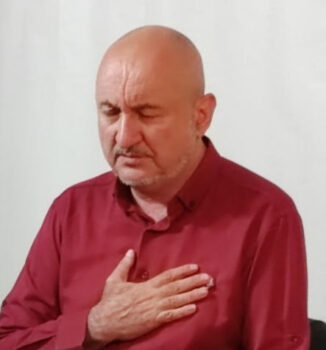
Yogacharya Leo Radutz