
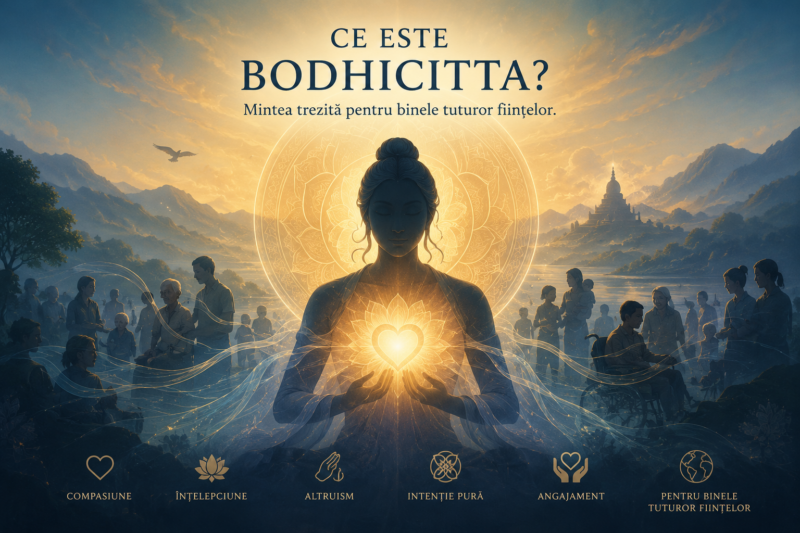
Bodhicitta
is one of the most important concepts
from Mahāyāna Buddhism
and Vajrayāna.
Literally, the word consists of:
- bodhi = awakening, enlightenment, full knowledge;
- citta = mind, heart, conscience, intention.
Therefore, bodhicitta means the mind (or heart) oriented towards enlightenment,
But its meaning is much deeper.
Classical definition
Bodhicitta is:
Sincere aspiration and firm
determinationto achieve full enlightenment
for the good of all beings.
I do not aim to liberate myself alone, but to become a Buddha so that I can help all beings to free themselves from suffering.
This is the ideal of the Bodhisattva.
Spiritual aspiration contains within it the goal – that is, spirituality.
The more intense it is, the more spirituality is already muffled in us to a certain extent.
Two Levels of Bodhicitte
In the Mahāyāna tradition, two aspects can be distinguished.
1. Relative Bodhicitta (saṃvṛti-bodhicitta)
It is universal love united with compassion and selfless intention.
It contains two stages:
- the desire to become a Buddha for the good of all;
- concrete commitment to go down this path.
This is the basis of practices such as:
- compassion,
- Generosity,
- patience,
- Tonglen,
- the six pāramitā.
2. Ultimate Bodhicitta (paramārtha-bodhicitta)
This is the direct realization of the ultimate nature of reality.
It is no longer just an intention, but the experience that:
- all phenomena are devoid of inherent existence;
- there is no separate self;
- Compassion and wisdom are inseparable.
In the Dzogchen and Mahāmudrā traditions this comes very close to recognizing the nature of the mind.
The Two Wings
In the Mahāyāna it is said that bodhicitta has two wings:
- wisdom (prajñā)
- compassion (karuṇā)
Only together do they lead to complete enlightenment.
Compassion without wisdom can become attachment.
Wisdom without compassion can become cold and incomplete.
How does bodhicitta appear?
The texts describe a process roughly as follows:
- you observe the suffering of all beings;
- empathy appears;
- empathy becomes compassion;
- compassion becomes responsibility;
- The decision appears:
“I will attain enlightenment so that I can help all beings.”
This is the moment of the birth of bodhicitte.
The two forms
Śāntideva explains two forms:
Bodhicitta of aspiration
“May I become a Buddha for the good of all.”
It is likened to the desire to go on a journey.
Bodhicitta of commitment
The person actually starts the practice.
It is similar to the fact that you have already started on the road.
In Vajrayāna
In the Vajrayāna it is said that:
“Without bodhicitta, tantra becomes a mere technique.”
All authentic initiations require the existence of bodhicitta.
It purifies motivation and prevents the practice from being used for the ego.
In Dzogchen
In Dzogchen, the perspective is even deeper.
It is sometimes said that:
- the nature of the mind is already pure;
- This nature is inseparable from spontaneous compassion.
Thus, when rigpa is recognized, genuine compassion occurs naturally, without deliberate effort.
It is no longer a moral obligation, but the natural expression of the realized state.
Practices for the development of bodhicitta
The best known are:
- meditation on the equality of all beings;
- changing oneself with others;
- Tonglen practice;
- the seven causes and one effect (attributed to Atiśa);
- the six pāramitā;
- cultivating the four boundless attitudes:
- love,
- compassion,
- empathic joy,
- Equanimity.
A Definition in One Sentence
A traditional formulation is:
“Bodhicitta is the determination to achieve full enlightenment in order to free all beings from suffering.”
From a more contemplative perspective, it can be expressed as follows:
Bodhicitta is the awakening of love and wisdom into a single consciousness, so that one’s own enlightenment is no longer an individual goal, but the natural expression of the good of all beings.
Acharya Leo Radutz