Yes, it is the instrument of freedom
Minimalism is presented today mostly as a lifestyle:
Fewer items, a simpler home, a smaller closet, fewer shopping.
All this can be useful.
But, seen from the perspective of Yoga, minimalism can become something much deeper:
the art of eliminating the surplus that consumes our energy,
fragments our attention
and prevents us from perceiving what is essential.
The goal is not to have as little as possible.
The goal is to become freer.
A man can have very few objects
and yet be dominated by desires, fears, attachments, ambitions and resentment.
Another can manage many things without being inwardly possessed by them.
That is why the real problem is not:
“How many things do I have?”
This:
“How many of them does my inner state depend on?”
Exterior minimalism is just the beginning
A crowded room can constantly demand attention.
Each object must:
kept,
cleaned,
maintained,
mutated,
protected,
repaired,
replaced.
That is why material accumulation inevitably produces
and a certain mental load.
But we can tidy up the whole house
and keep in mind an enormous repository of useless things:
worries,
Sorry,
conflict,
information,
comparisons,
unimportant projects,
endless desires.
Yogic minimalism starts with things, but it doesn’t stop at things.
He continues with:
the minimalism of desires,
the minimalism of information,
the minimalism of concerns,
the minimalism of
reactions and, finally, the minimalism of identifications.
APARIGRAHA – the freedom not to accumulate
One of the five yamas in Patañjali’s Yoga is the aparigraha.
The term can be translated as:
non-accumulation, non-possessiveness, the absence of greed to take and keep.
It is probably the yogic concept that comes closest to what we call minimalism today.
But the apparition goes on.
It doesn’t necessarily say:
“He didn’t have things.”
Says:
“Don’t tie yourself to them.”
Patañjali states:
aparigrahasthairye janmakathaṃtāsaṃbodhaḥ
“When the aparigraha is firmly established,
Deep Knowledge Emerges
of the way in which existences [births] take place.’
— Yoga Sūtra II.39. (Wisdom Library)
It is remarkable that Patañjali does not describe here
only an economic or psychological advantage of non-accumulation.
He attributes to it a consequence of knowledge.
Why is that?
Because accumulation is not only material.
Each attachment maintains a direction of mind.
“This is my home.”
“This is my position.”
“This is my reputation.”
“This is my object.”
“This is my person.”
“This is my story.”
Around these possessions a part of the ego’s identity is built.
The more such threads there are, the more the consciousness is trapped in the network of the outside.
The Aparigraha begins to cut these threads.
To have without being possessed (not without possessing)
Yogic minimalism does not assert that objects are evil.
The problem is addiction.
A phone can be a great tool.
But we can end up unable to go twenty minutes without checking it.
A house can be beautiful and useful.
But we can end up defining ourselves by it.
Money can greatly amplify the ability to achieve good things.
But they can become the center of our psychological security.
Thus we can end up in a paradoxical situation:
we think we own things,
But things possess some of our attention.
True freedom does not consist in the impossibility of having.
It consists of the ability to:
to have without attachment
and not to have without unnecessary suffering.
VAIRĀGYA – the minimalism of desire
Aparigraha is closely related to another fundamental concept:
Vairāgya
Vairāgya is often translated as detachment or renunciation.
But it does not mean indifference.
It does not mean a lack of love.
It does not mean apathy.
Patañjali defines it as follows:
dṛṣṭānuśravikaviṣayavitṛṣṇasya vaśīkārasaṃjñā vairāgyam
that is, the state of inner mastery
of the one who is no longer thirsty for the objects of pleasure
perceived or heard about.
— Yoga Sūtra I.15. (Wisdom Library)
The important word here is vitṛṣṇa:
the absence of “thirst”.
Each attachment maintains a direction of mind.
The problem is not the experience.
The problem is the compulsive thirst for experience.
Man can admire beauty without wanting to possess it.
He can taste good food without becoming addicted to it.
He can love without turning love into possession.
He can be successful without becoming a slave to success.
This is a much deeper form of minimalism.
We are no longer reducing the number of objects.
We reduce the number of things we think we need to be happy.
Desire Produces a Permanently Incomplete Life
There is a very simple mechanism of the mind:
“I’ll be fine when…”
… I’m going to get that thing.
… I’ll have more money.
… I’ll have another house.
… I will end up in a certain position.
… I will have the partner I want.
… I will receive the recognition I want.
After the condition is met, another one appears.
And then another.
Thus man can live for decades in a subtle state of postponement of happiness.
Yogic minimalism produces a radical reversal:
instead of constantly asking
“What else do I need?”
We start asking
“What can I discover if I stop believing that I’m constantly missing something?”
SAṂTOṢA – the discovery of “is enough”
Here another fundamental yogic virtue appears:
Saṃtoṣa – Deep Contentment
Patañjali states:
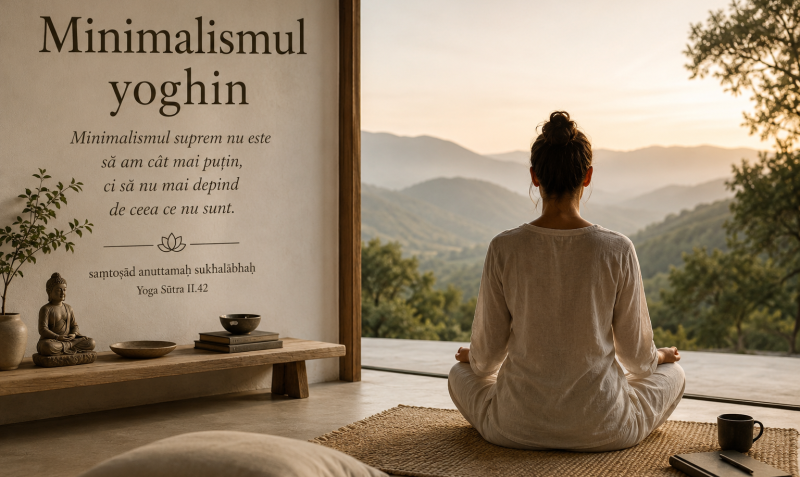
saṃtoṣād anuttamaḥ sukhalābhaḥ
“From contentment an unsurpassed happiness is acquired.”
— Yoga Sūtra II.42. (Wisdom Library)
Saṃtoṣa does not mean mediocrity.
It does not mean:
“I’m not trying to evolve anymore.”
We can aspire enormously and still be satisfied inside.
We can build.
We can create.
We can transform the world.
We can pursue excellence.
But without the permanent feeling:
“I can’t be well until the outside becomes different.”
This difference is huge.
One is:
aspiration.
Another is:
compulsive dissatisfaction.
The first can lead to evolution.
The second holds us captive.
“Enough” is a revolutionary word
Much of the modern economy works by the message:
“You don’t have enough yet.”
You’re not pretty enough.
Your phone isn’t new enough.
Your house is not big enough.
Your vacation is not spectacular enough.
Your life is not interesting enough.
You have to buy something else.
You have to become something else.
You still have to show something to others.
Saṃtoṣa introduces a very dangerous word for this logic:
ENOUGH
The man who knows when enough is enough becomes very difficult to manipulate by desire.
This is one of the great powers of minimalism.
Luciferic Drama:
The more we exert ourselves,
Seeking fulfillment in the external
the more catalysts we need for satisfaction
for the same level of satisfaction.
PRATYĀHĀRA – the minimalism of stimuli
Another dimension of yogic minimalism appears through pratyāhāra.
Patañjali defines pratyāhāra by withdrawing the senses from their habitual contact with objects, so that they follow, in a certain sense, the nature of the mind:
svaviṣayāsaṃprayoge cittasvarūpānukāra ivendriyāṇāṃ pratyāhāraḥ
— Yoga Sūtra II.54. (Wisdom Library)
In the contemporary world we are subjected to a huge amount of stimuli.
Phone.
Facebook.
TikTok.
YouTube.
News.
Advertising.
Messages.
Music.
Videos.
Notifications.
Images.
Comments.
They all compete for the same resource:
our attention.
That is why informational minimalism can become a very effective preparatory form for pratyāhāra.
We don’t need to see everything.
There is no need to read everything.
There is no need to answer everything.
We don’t need to know what’s going on everywhere all the time.
Sometimes freedom begins with a very simple gesture:
I don’t pay attention to things that don’t deserve my attention anymore.
Attention is energy
In Yoga, attention is not something unimportant.
Where attention goes repeatedly, that’s where the energy of the being is also trained.
That is why continuous dispersion is expensive.
A hundred concerns means a hundred threads through which our energy spreads.
Yogic minimalism tries to reduce this fragmentation.
Fewer directions.
But followed deeply.
Fewer concerns.
But important.
Fewer practices done superficially.
But essential practices carried out constantly.
This can radically transform the effectiveness of a sādhana.
The Minimalism of Spiritual Practice
And spiritual practice can get busy.
We can collect:
initiations,
mantra,
techniques,
books,
courses,
methods,
rituals,
teachers,
philosophies.
There is a risk that man will become a collector of spirituality.
He knows something about a hundred techniques, but he doesn’t deeply practice any of them.
Spiritual accumulation can also become a form of parigraha.
Sometimes evolution accelerates when man identifies:
its core practices
and realizes them deeply enough.
A single technique performed with perseverance can be worth more than twenty intellectually known.
Spiritual minimalism does not say:
“There is only one good technique.”
Says:
“Don’t confuse the number of known methods with the depth of transformation.”
Interior minimalism
But we can go even further.
There are things that we don’t keep in closets.
We keep them in our identity.
“I am the man to whom this was done.”
“I am this position.”
“I am this reputation.”
“I am this success.”
“I am this failure.”
“I am this story.”
These are also forms of accumulation.
We accumulate identities.
We accumulate stories about ourselves.
We accumulate the past.
And then we try to protect the entire edifice.
From a spiritual perspective, minimalism can gradually become the question:
“How many of the things I call ‘I’ are really I?”
Here minimalism ceases to be a method of organizing the home.
It becomes a method of self-knowledge.
We don’t eliminate the world – we eliminate confusion
Authentic yoga does not have to lead to hatred of the world.
Beauty should not be rejected.
Prosperity should not be demonized.
Comfort is not a sin.
Art, technology, homes, beautiful objects, and human achievements can perfectly have their place in a spiritual life.
The problem begins when we confuse these things with the ultimate source of fulfillment.
Yogic minimalism does not say:
“The world is worth nothing.”
This:
“Don’t ask the world to give you what only the discovery of your deep nature can offer you.”
The Trap of Selfish Asceticism
There is also a false form of minimalism.
“I only have three T-shirts.”
“I sleep on the floor.”
“I don’t use that.”
“I’m less materialistic than others.”
Then minimalism becomes another ornament of the ego.
We eliminated the objects, but we kept the pride.
We gave up comfort, but we accumulated superiority.
From a yogic perspective, this is not a great victory.
There is no automatic spiritual merit in discomfort.
A comfortable bed does not necessarily impede lighting.
And a hard floor doesn’t guarantee it.
The real criterion is:
How free am I?
An exercise in yogic minimalism
We can periodically look at each area of life and ask a few questions.
About objects
Is it really useful to me?
Do I use it?
Does it simplify my life or complicate it?
Do I keep it out of necessity or out of attachment?
About the information
Do I need to know this?
Does this information increase my discernment or does it just occupy my mind?
About activities
Does this activity serve something important?
Or does it continue only out of inertia?
About relationships
Is this relationship genuine?
Is there love, truth, responsibility, or meaning in it?
About thoughts
Is it necessary for me to continue thinking this?
About wishes
Is this a genuine aspiration?
Or just another form of anxiety?
About identity
What am I trying to protect when I say:
“Me”?
Minimalism is not little. It means essential.
A minimalist life can even be very rich.
Rich in love.
Rich in knowledge.
Rich in experiences.
Rich in creativity.
Rich in authentic relationships.
Rich in spiritual practice.
What disappears is the ballast.
We don’t eliminate wealth.
We eliminate the noise that prevents us from perceiving true wealth.
From simplification to freedom
We can see yogic minimalism as a sequence:
Fewer useless
objects→ fewer unnecessary concerns
→ fewer compulsive desires
→ less dispersion
→ more available
energy→ more attention
→ more presence
→ more freedom.
At this point, minimalism is no longer a design style.
It becomes an inner technology.
Ultimate minimalism
There is, finally, an extreme and very profound form of spiritual minimalism.
At the beginning we ask:
“What objects don’t I need?”
Later:
“What desires don’t I need?”
Then:
“What thoughts don’t I need?”
And maybe, one day:
“What identifications don’t I need to exist?”
Then it may become apparent that the deep nature of the being is not to be built by accumulation.
We don’t need to add anything to the Self for the Self to be complete.
From the nondual perspective, what we seek is not produced by accumulation.
It is already present, but covered.
That is why the spiritual path also contains a process of simplification.
We don’t necessarily build Reality.
We remove what prevents us from recognizing it.
In this perspective, ultimate minimalism is not:
“to have as little as possible”.
This:
to stop depending on what I am not.
To use things without being used by them.
To enjoy myself without getting attached.
To love without possessing.
To act without getting lost in the action.
To live in the world without the world occupying my entire consciousness.
And, beyond the accumulations of life and mind, may what has always been present remain more and more evident:
Consciousness itself.
I think this is where the strongest idea for the Abheda perspective appears: “the ultimate minimalism is not to have as little as possible, but to stop depending on what I am not.”