

Why do I need virtues?
To make you feel good.
They are like precious skills, which smooth the way to better.
Their goal is not to form an obedient or just “virtuous” man,
but of a sober, free inner man, loving, lucid and capable of acting wisely in the world.
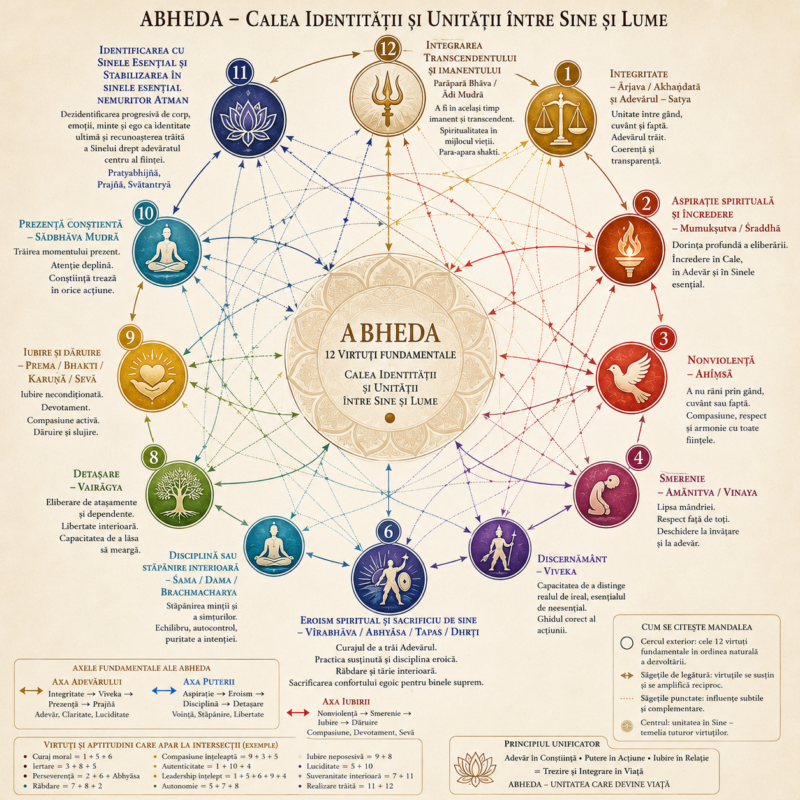
Abheda Yoga aims to cultivate many spiritual virtues and human skills,
among which 12 are considered fundamental:
1. Integrity – Ārjava / Akhaṇḍatā and Truth – Satya
2. Spiritual Aspiration and Confidence – Mumukṣutva / Śraddhā
3. Nonviolence – Ahiṃsā
4. Humility – Amānitva / Vinaya
5. Discernment – Viveka
6. Spiritual Heroism and Self-Sacrifice – Vīrabhāva / Abhyāsa / Tapas / Dhṛti
7. Discipline or Inner Mastery – Śama / Dama/Brachmacharya
7. Detachment – Vairāgya
9. Love and Giving – Prema / Bhakti / Karuṇā / Sevā
10. Conscious Presence – Sādbhāva Mudrā
11. Identification with the Essential Self and Stabilization in the Immortal Essential Self Atman
Progressive disidentification of body, emotions, mind and ego as ultimate identity
and the lived recognition of the Self as the true center of being.
Pratyabhijñā, Prajñā, Svātantrya
12. Integration of the Transcendent and the Immanent – Parāparā Bhāva / Ādi Mudrā in Abheda Terminology
– to be both immanent and transcendent,
the third branch of Shiva’s trident,
Spirituality in the middle of life, para-defends shakti.
-
The Matrix of the 12 Abheda Roots
|
# |
Root |
The essence |
Its false imitation / deformation |
Virtues and skills that can derive |
|---|---|---|---|---|
|
1 |
Integrity – Ārjava / Akhaṇḍatā |
They are one and the same in conscience, thought, word and deed. I respect the truth even when it costs me. |
“Brutal sincerity”; moral rigidity; cultivating an image of a man of integrity. |
satya, authenticity, responsibility, loyalty, fairness, honor, consistency, moral courage |
|
2 |
Spiritual Aspiration – Mumukṣutva / Śraddhā |
Life has a higher direction and I consciously choose to strive for it. |
Fleeting enthusiasm; credulity; fanaticism; idealism without practice. |
hope, trust, perseverance, lucid idealism, orientation towards meaning, fidelity to the path |
|
3 |
Nonviolence – Ahiṃsā |
I avoid unnecessary suffering and act to protect life and lessen suffering. |
Cowardice, passivity, inability to say “no”, avoidance of the necessary confrontation. |
gentleness, patience, tolerance, forgiveness, protection, respect, kindness |
|
4 |
Humility – Amānitva / Vinaya |
I see myself lucidly, without overvaluing myself and without undervaluing myself; remain able to learn. |
Self-devaluation, servility, theatrical humiliation, “I am nothing” said by a spiritual ego. |
receptivity, gratitude, simplicity, learning capacity, respect, modesty |
|
5 |
Discernment – Viveka |
I distinguish the real from the apparent, the essential from the non-essential, the truth from the false, and the right action from the inappropriate. |
Criticism, intellectualism, continuous suspicion, judging others. |
lucidity, prudence, justice, clarity, common sense, practical wisdom |
|
6 |
Spiritual Heroism – Vīrabhāva / Abhyāsa / Tapas / Dhṛti |
They do what is necessary even when it is difficult; Continue until the transformation becomes real. |
Aggressiveness, demonstrative heroism, obstinacy, egoic asceticism. |
courage, tenacity, perseverance, willpower, active patience, initiative, resilience |
|
7 |
Inner Mastery – Śama / Dama/Brachmacharya |
The mind, senses, and impulses are my tools, not my masters. |
Repression, rigidity, obsessive control, permanent struggle with oneself. |
self-control, concentration, temperance, patience, emotional balance, stability |
|
8 |
Detachment – Vairāgya |
I can love, act, and participate intensely without becoming a prisoner of the object, outcome, or success. |
Indifference, coldness, affective avoidance, abandonment of responsibilities. |
inner freedom, simplicity, generosity, serenity, independence, balance in success and failure |
|
9 |
Love and Giving – Prema / Bhakti / Karuṇā / Sevā |
I go beyond the egoistic center and experience the good of the other and the whole as relevant to me. |
Attachment, possessiveness, sentimentality, compulsive “saving” others, neurotic sacrifice. |
compassion, generosity, devotion, friendship, forgiveness, solidarity, sap |
|
10 |
Conscious Presence – Sādbhāva Mudrā |
I’m here; I realize that I exist and I don’t completely get lost in the automatic flow of the mind and life. |
Hypercontrol of attention, tension, simple mental concentration; refusal to plan under the pretext of the “present moment”. |
attention, lucidity, spontaneity, calmness, obedience, capacity for contemplation |
|
11 |
Self-Identification and Self-Stabilization– Pratyabhijñā; Self-Stabilization / Prajñā |
The center of identity shifts from the egoic construct to the deep nature of consciousness. |
“I am Śiva” only intellectually; spiritual inflation; spiritual bypassing. |
inner freedom, prajñā, fearlessness, spiritual equality, profound autonomy |
|
12 |
The Integration of the Transcendent and the Immanent – Ādi Mudrā, in Abheda Terminology |
I remain anchored in the deep nature of consciousness as I love, create, work, lead, and act in the world. |
“Everything is spiritual, so whatever I do is fine”; or, conversely, fleeing from the world in order to preserve a supposed spiritual purity. |
Dharma Lived, Karma Yoga, Creativity, Wise Leadership, Efficiency Without Alienation, Spirituality in the Midlife |

Leo Radutz