💠 Comunitatea Abheda
Dacă spiritualitatea, bunătatea și transformarea fac parte din căutarea ta, te invităm în comunitatea noastră.
📲 Telegram –
t.me/yogaromania
📲 WhatsApp –
Comunitatea WhatsApp
It depends on what you want to do on that vacation.
The sea and the mountains favor different inner processes.
For Rucăr I would formulate the central idea as follows:
The sea especially favors relaxation and horizontal expansion.
The mountain favors recollection, verticalization and transformation.
This is a spiritual and phenomenological interpretation,
not a scientific statement or a traditional quote.
Why the mountain can be more suitable for a spiritual vacation
1. The mountain favors the spontaneous withdrawal of attention from the outside – pratyāhāra.
In the mountains there is, as a rule, less commercial, social and sensory stimulation than in a seaside resort: less crowds, music, advertisements, restaurants, nightlife, permanent social exposure.
Attention thus has the chance to stop “chasing after objects”.
It is not the mountain that automatically produces pratyāhāra, of course.
A man can stay on the phone for ten hours in a cabin.
But the environment may no longer fight against the practice.
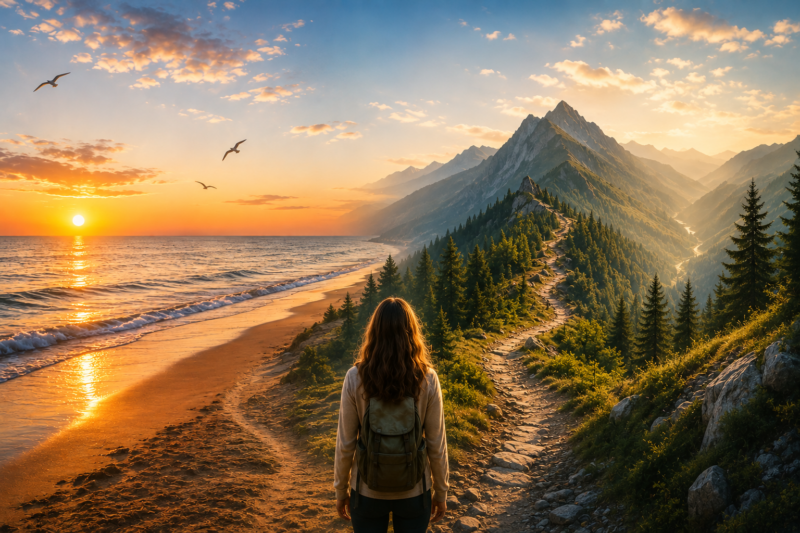
2. The mountain naturally induces a certain verticality.
It is probably the strongest symbolic difference between the mountain and the sea.
The sea offers the infinite horizon, the expanse and the dissolution of limits.
The mountain offers the ascent.
The ascent has an almost inevitable correspondence with spiritual effort:
overcoming, aspiration, tapas, perseverance, conquering one’s own inertia.
This should not be turned into an esoteric statement such as “the mountain has vibration X”. Direct experience is sufficient: man looks up and walks upwards.
3. Physical exertion can become tapas.
A walk on the beach is wonderful,
But hiking inevitably involves some effort:
you climb, sweat, regulate your breathing, continue when fatigue appears.
If consciously integrated into a retreat, such an activity can become practical:
walking → breath → presence → overcoming inertia → contemplation.
Instead of just being a sport, it can become a simple form of sādhanā.
4. The silence of the mountain is very conducive to meditation.
The rustle of the forest, the wind, the water and the rare sounds of nature
produce a much less fragmented sensory background
than the urban or tourist environment.
5. The mountain favors interiorization, inner alertness, proactivity,
without necessarily favoring passivity, which at sea, unfortunately, tends to increase.
A holiday by the sea can very easily become:
Beach → food → phone → sleep → fun → beach again.
There is nothing wrong with that.
It can be exactly the rest that someone needs.
The mountain, however, invites more easily to:
awakening → practice → going → effort → contemplation → silence → practice.
It is a vacation that can regenerate you and at the same time mobilize you.
But the sea also has real spiritual advantages
The sea is extraordinary, in the case of certain people, for the expansion of consciousness.
The unobstructed horizon can support contemplation of space and limitlessness.
The repetitive rhythm of the waves can promote calm and an almost meditative state.
Water symbolically and psychologically favors abandonment, fluidity and the dissolution of rigidities, if you strive for it.
Sun, swimming and lack of usual demands
can produce a very deep regeneration.
We can make a simple comparison:
| The | The Mountain |
|---|---|
| Expansion | Verticalization |
| abandonment | conscious effort |
| Fluidity | Stability |
| dissolution | structuring |
| relaxation | tapas |
| Ascension | |
| Contemplation of | Contemplation of Height |
| rest | transformation |
| “I’m leaving” | “I’m surpassing myself” |
None of the columns is “superior” in itself.
For the concrete choice “mountain or sea?”
People probably don’t compare a spiritual retreat in Rucăr with a spiritual retreat on a deserted beach, but they compare a time spent in a spiritual center in the mountains with a regular vacation on the seaside.
In this comparison, the advantage of the Rucăr becomes much greater.
If a person comes to Rucăr and has:
morning practice, meditation, Hatha Yoga, pranayama, periods of silence, conscious walking through nature, teaching, communion with people who have the same aspiration, simple eating, less phone and evenings without the hustle and bustle of a tourist resort,
We are no longer comparing two tourist destinations.
We compare:
vacation as an interruption of ordinary life
with
vacation as an opportunity to transform ordinary life.
Why a spiritual vacation in the mountains and not just a vacation by the sea?
At the sea you can rest.
In the mountains you can rest and climb.
Not only on the mountain.
But in yourself.
The sea invites us to surrender to the vastness.
The mountain invites us to discover the strength to overcome our limits.
In Rucăr, nature is not only the setting of the holiday.
It can become part of the practice: hyperlucidity, silence for meditation, forest for interiorization, walking for presence, climbing for tapas, naturally proactive attitude (compared to abandonment in inactivity at sea), vastness for contemplation and community for supporting transformation.
You can come back from a vacation rested.
But you can also come back differently.
We propose – for real the holiday – which is at the same time
rest, spiritual experience and transformation.
Leo Radutz