💠 Comunitatea Abheda
Dacă spiritualitatea, bunătatea și transformarea fac parte din căutarea ta, te invităm în comunitatea noastră.
📲 Telegram –
t.me/yogaromania
📲 WhatsApp –
Comunitatea WhatsApp
Hatha Yoga and Raja Yoga are not,
In the classical tradition, two rival paths.
Rather, they represent
two complementary directions of the same transformation:
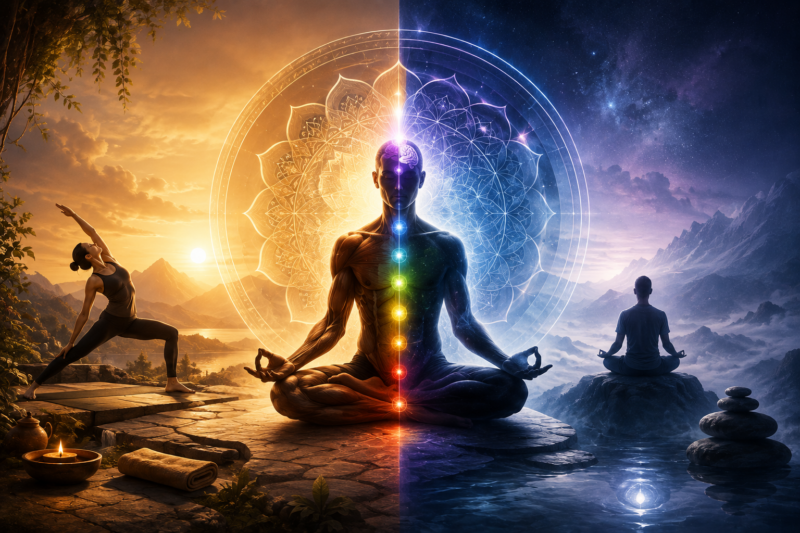
- Hatha Yoga acts predominantly from the bottom up: through the body, breath, prana and subtle structure.
- Raja Yoga acts predominantly from the top down: through attention, willpower, discernment, meditation and the control or transcendence of mental activity.
The essential difference
Hatha Yoga: especially mastering prana for mastering the mind
Traditional Hatha Yoga is not just about body postures.
It includes:
- shṭkarman – purification processes;
- asanas, that is, motionless yogic postures;
- pranayama;
- bandhas – contractions and mudras – attitudes, especially physical-energetic;
- the awakening and ascension of Kuṇḍalinī;
- the penetration of the praṇa into Suṣhumṇa;
- nadanusandhana or contemplation of the subtle mantric sound;
- laya-dissolution of the mind and then samadhi.
Its starting point is the practical finding that
The mind and prana are deeply linked:
when prana is agitated, the mind is agitated;
when prana is stabilized and internalized,
The mind can enter silence much more easily.
Therefore, Hatha Yoga aims to produce the meditative state
working on its energetic and bodily support.
Raja Yoga: Direct Mastery of the Mind
Raja Yoga is associated, in the most widespread sense, with the Yoga of Patañjali.
The fundamental definition is:
yogas-city-vritti-nirodhah
“Yoga is stopping, suspending or resorption.
fluctuations of mental consciousness.” — Yoga Sutra
Its tools are the eight components:
“Yama, Niyama, Asana, Pranayama, Pratyahara, Dharaṇa, Dhyana and Samadhi are the eight members.” — Yoga Sutra
So, Raja Yoga is not just meditation.
It includes ethics, personal discipline, posture and breathing,
but the center of gravity is:
- pratyahara – internalization of the senses;
- dharaṇa – concentration;
- dhyana – meditation;
- samadhi – supramental absorption.
The traditional connection between them
Hatha Yoga Pradipikexplicitly stated that Hatha Yoga
is a gateway to Raja Yoga:
The very first sutra compares Hatha Yoga
with a ladder on which the practitioner climbs to the high Raja Yoga.
But the text doesn’t just say that Hatha is inferior or provisional.
He affirms their interdependence:
“Without Hatha, Raja Yoga fails; without Raja Yoga, Hatha fails.
Therefore, the two must be practiced together until full realization.” — Hatha Yoga Pradīpikā
This is probably the most accurate classical formulation of the relationship between them.
Raja Yoga can also mean the final state
In Hatha Yoga Pradīpikā, “Raja Yoga” does not necessarily designate
a separate school or exclusively the system of Patañjali.
Sometimes it even designates the supreme state achieved, being listed together with:
- samadhi;
- unmani – the state beyond the mental;
- Manonmani;
- laya;
- advaita;
- sahaja;
- jīvanmukti;
- turiya.
The text says that these terms are, in that context,
names of the same fundamental achievement.
Therefore:
Hatha Yoga is the psychophysiological and energetic process,
and Raja Yoga is both the meditative dimension,
and, sometimes, the royal fulfillment of the process.
A practical comparison
Aspect ratio | Hatha Yoga | Raja Yoga |
|---|---|---|
Main gate | The body and prana | Mind and consciousness |
Predominant instrument | Breathing, mudrā, bandha, Kuṇḍalinī | Concentration, meditation, discernment |
Obstacle tackled directly | Energy blockage and psychophysical instability | Vṛtti, Distraction, and Mental Identification |
Characteristic process | Purification, balancing, internalization of prana | Pratyāhāra, dhāraṇā, dhyāna, samādhi |
Close result | Active Suṣumṇā, stability of prana, laya | Nirodha, Samādhi, Liberation of Consciousness |
The relationship between them | Prepare and support Raja Yoga | Give meaning and finality to Hatha practices |
A modern simplification that, in my opinion, must be avoided
It is sometimes stated:
“Hatha Yoga represents the first four members, and Raja Yoga the last four.”
This division is, in my opinion, not rigorously accurate.
Traditional Hatha Yoga also contains meditation, laya, nada, and samadhi.
At the same time, Patañjali’s system includes asana and praṇayama.
So, the two domains overlap;
the difference is mainly in the focus and method of access,
not of an absolute border.
The Deepest Understanding
The connection between praṇa and mind can be expressed as follows:
- Hatha Yoga calms the mind by mastering praṇa.
- Raja Yoga calms praṇa by mastering the mind.
- In samadhi, the difference between the two methods disappears.
From the perspective of an Abheda practice, I would formulate it like this:
Hatha Yoga purifies, energizes and unifies the instrument of the being – the sheaths, the bodies of the being or the vehicles of the being;
Raja Yoga orients this instrument the bodies or vehicles – towards transcending the mind and identifying with the immortal essential Self.
Hatha without Raja risks becoming bodily or energetic performance;
The Raja without Hatha risks remaining a mental aspiration devoid of the support of the real transformation of the being.
They become complete only together.
Thus, Hatha is the “transforming force”,
and Raja is, somehow, “the sovereignty of conscience”.
Acharya Leo Radutz – Abheda Yoga