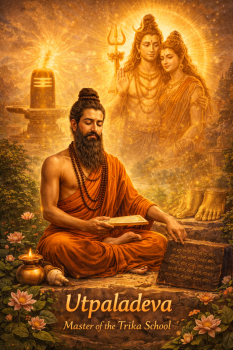
Utpaladeva was one of the greatest masters of Kashmiri Shaivism.
The great mystical saint of Kashmir is also known as Utpala or Utpalacharya, but also Jnoon-e-Kamil- wise in divine ecstasy.
His life
<>
Utpaladeva was a precocious child with a sharp intellect, with a great desire for knowledge and transformation. Impelled by this desire, by a great spiritual aspiration and a great love of God, he accumulated deep mystical knowledge and became a perfect divine model.
The son of Udayakar, he lived around the middle of 900 d.Hr. and lived somewhere in Nauhatta (Navyut) in Srinagar.
Distinguished by his outstanding qualities, he was taken as a disciple of the great philosopher Siddha Somananda , whose great Shivadrishti work, Pratyabhijnya Shastra (The Philosophy of Recognition) inspired Utpala to write Ishwar Pratyabhijnya Karikas .
In Shivadrishti it is said that Utpala was motivated to write Karikas at the request of his son, Vibhramakara .
In this work, he synthesized the teachings of his master and speaks of it as “a reflection of the wisdom taught by Somananda.”
In fact, tradition says that Utpala was often in a deep state of spiritual ecstasy. He wrote important works, which are the expression of his state of liberated being who lives permanently in total identification with God.
“Oh my God!
Sit next to me
and listens briefly to the brief definition of pleasure and pain .
What is union with You is pleasure
and what is separation from You is pain.”
Founder of Pratyabhijna School
<>
He was, along with Abhinanagupta, one of the most important masters of the Pratyabhijna school.
The name of this school is derived from the name of the Shhivait text, written in Sanskrit by the liberated great master Utpaladava, around 1000 BC – “Ishavaprathyabijnakarika” (aphorisms about the direct recognition of the Dignity in ourselves).
Shevaism is considered to be the oldest spiritual path in the world, a fact attested by archaeological excavations at Mohenjo Daro and Harappa which indicate its existence even beyond Chalcolithic.
Pratyabhijna is one of the most important schools of Casmiri Shahivaism in the Trika system. There are several important schools of Kashmiri Shaivism, but the Trika system encompasses the highest ones.
“Pratyabhijna” means
“to recognize yourself, to spontaneously realize your Self once again”
or
“the recognition, the reminder of our divine nature”.
It means realizing who we really are and finding ourselves back. That’s the philosophy behind this system.
In short, this term that refers to the direct recognition of the Divine Essence.
“Oh, my God!
You may have increased your desire for the objective world just like other people,
but with this difference that I will regard it as Yourself, without any idea of duality.”
On this path there is no “upaya“, that is, means, ways or instruments of transformation, but the cultivation of inner attitudes in order to awaken the Divine Consciousness within us at once.
It is also called the “easy and very short way“, being accessible to very few very high beings.
Its philosophy
<∞ The Infinite Symbol – Origin, Meaning, Benefits ~ FOLconcept” data-noaft=”1″ width=”434″ height=”204″>
“O Lord,
the one who sees (truly)
recognizes the entire objective world
as a purely non-relational consciousness.
Thus, the identification of the individual consciousness with the universal Consciousness appears, and,
as a result,
the attainment of divine Happiness,
where or who does someone need to be scared of? “
He asserts that supreme spiritual liberation is essentially a total and irreversible recognition that our true identity is eternal, immutable, and ineffable.
Man lives in suffering and limitation because he has forgotten his true identity. But he can emerge from samsara through a direct and spontaneous knowledge of his essential nature, through the spontaneous recognition of his identity with the Supreme Self Atman.
This revelation is a total and overwhelming manifestation of divine grace.
<‘t Know Before Now’ data-noaft=”1″ width=”476″ height=”268″>
Somananda explained Utpala’s doctrine with the following example:
“
A girl and a boy whose marriage was established by their relatives
and who have not seen themselves happen to sit with their friends and relatives at a fair.
The girl happens to serve the boy with refreshments.
As a matter of course, there is a special feeling between the two.
But when the future marriage of the couple is suggested, suddenly feelings of love appear in both the boy and the girl.
The girl recognizes her lover.
This is Jiva’s recognition with Shiva.”
In this way the philosophy of Pratyabhijnya as taught by Utpala is briefly described.
Upta’s teaching was continued by Lakshmangupta, who was abhinavagupta’s master.
His works
-
Pratyabhijnya Karikas – Sutras or “Verses on the Acknowledgment of the Lord”
- <?zip=/3/items/PratyabhijnaKarikaOfUtpaladevaDr.R.K.Kaw/Pratyabhijna%20Karika%20Of%20Utpaladeva%20-%20Dr.%20R.K.%20Kaw_jp2.zip&file=Pratyabhijna%20Karika%20Of%20Utpaladeva%20-%20Dr.%20R.K.%20Kaw_jp2/Pratyabhijna%20Karika%20Of%20Utpaladeva%20-%20Dr.%20R.K.%20Kaw_0000.jp2&id=PratyabhijnaKarikaOfUtpaladevaDr.R.K.Kaw&scale=8&rotate=0″ alt=”Book page image” width=”229″ height=”361″>
Although Ishwar Pratyabhijnya is difficult to study and understand, it is nevertheless a perfect work of philosophy that provides the devotee with the knowledge necessary to make a leap into levels of consciousness.
It is not only a set of philosophical doctrines, but also contains instructions on practical Yoga .
-
Shivastotravali (with Kshemaraja’s commentary in Sanskrit and Hindi commentary by Swami Lakshman Joo
- <?q=70″ srcset=”https://rukminim1.flixcart.com/image/832/832/ki4w0i80-0/book/0/a/f/sivastotravali-of-utpaladeva-original-imafxzgahbtruh3h.jpeg?q=70 2x, https://rukminim1.flixcart.com/image/416/416/ki4w0i80-0/book/0/a/f/sivastotravali-of-utpaladeva-original-imafxzgahbtruh3h.jpeg?q=70 1x” alt=”Sivastotravali of Utpaladeva”>
“Shivastotravali” is a poem, which was written after a period of intense and deep states of divine ecstasy (samadhi) and is a mirror of his exceptional spiritual experiences.
His disciples, Sri Rama and Adityaraja, along with Vishvanatha, structured this poem into 20 chapters which except for chapters thirteen and fourteen which were written by Utpaladeva in a complete state of lucidity.
-
Ishwara-Siddhi
-
Ajadapromatri-Siddhi .