
💠 Comunitatea Abheda
Dacă spiritualitatea, bunătatea și transformarea fac parte din căutarea ta, te invităm în comunitatea noastră.
📲 Telegram –
t.me/yogaromania
📲 WhatsApp –
Comunitatea WhatsApp
The Great Divine or Divine Powers Dasa Maha Vidya
is a transpersonal transformation system with tools consisting of:
- Yantra
- Mantras
- Symbolic iconographic representations – which can be used as a mandala or a meditation icon
- and an associated metaphysics.
These practices have the ultimate goal
supreme attainment, salvation, moksha, spiritual liberation,
in order to achieve the passage of the being from the finite to the infinite,
from ignorance to knowledge, from what is transient to what is impassable,
from immanence to transcendence
starting from love, passion and concern or, even, attachment
to the world, what is still limited.
These are in fact aspects of the natural life of man which,
Although still a “man of desire”, he seeks limitlessness, salvation or … God,
starting from the experience of the Knowledge of the world.
Vidya means knowledge
and this will mean, in the end,
the knowledge or living of identity
with the Supreme Being or God, the Lord God or the Supreme God.
That is why it is said that these Maha vidyas in number are with one end in immanence, in manifestation or in the natural life of man
And with an end in non-manifestation, in transcendence
or in God or the One Supreme Being.
They represent a complete system
These 10 so-called Goddesses represent the “360 degrees”,
the complete circle of human experiences that can lead the authentic
Seeker from immanence to transcendence.
Therefore, regardless of the resemblance of any Maha Vidya
to one or the other of the Hindu goddesses,
she is absolutely different from them
by the specific role she has within
the system of the 10 Mahavidyas or Dasa MahaVidya.
They are different facets of the same one goddess
God in his feminine hypostasis and, therefore,
any of them contains all the others,
but manifests more or less easily certain specificities.
It is as if we look at a goddess from the left, from the right, from above or from below,
observing and worshipping first certain aspects and not others
that are, in that situation, further and smaller in our vision.
Chinnamasta – the great Divine Power of lightning spiritual evolution
Evolution in this way is characterized by the courage to accept the transcendence of many dogmas, usual principles in favor of the fastest evolution.
This evolution is not propelled by the courage of direct confrontation,
but by the unbridled passion of spiritual aspiration that makes difficult
problems be transcended in a flash, as if they had not been.
Chinnamasta is characterized by transcending mental obstacles through inner “surrender” or abandonment of the ego (which actually exists at the level of the mind) to the longing for the infinite.
That’s why her name means “The Headless Goddess.”
Features
- Chinnamasta is the sixth Great Divine Power of divine wisdom and rapid transformation, also known as the “
headless goddess
“, which gives us the perfect discernment. - Chinnamasta offers us the possibility to accelerate but also to “resist” the rapid spiritual evolution.
The speed of spiritual evolution is always limited especially by how much we accept, unconsciously, from the gigantism of the infinite within us - It also gives us speed and courage, solid inner support, clarity of mind and inspired lightning-fast decisions.
- It helps us to use the mind and the ego as an instrument of the soul.
- It supports us to be able to use a large ego, which gives us the power of action but also strengthens our limits
in a way that it is only a docile instrument of the true center of the being that is the essential soul and self.
In “Gupta Lalitambika” Chinnamasta is described as follows:
“She who is the embodiment of virtue, of love, of humanity, of anger, of courage, of terror, of mysticism, of humor and tranquility, all put together.” – Nelson Mandela
Why virtue?
Because accelerated spiritual evolution is not possible without a “surrender” of the ego to wisdom, transformation, and transcendence.
Why love?
Because it is pure love that follows the “surrender” and animates the soul.
Why of humanity!
Being human is to understand that man’s guidance to the infinite can only act with the finite of his powers, but accepting that this finite is nothing—that is, immeasurable—toward the infinity of consciousness.
Why anger?
Not just any anger. The fury of not accepting self-indulgency.
Of courage?
Yes, because spiritual evolution is actually limited by the ego’s fear that something undesirable might happen to it.
Of mysticism?
Because accelerated spiritual evolution is so astounding, that it cannot be grasped by the human mind – it, the mind, will need to consider it a divine “hocup-pocus”.
Humor comes from courage and silence… they do, silence is too-pure divine stillness, the mental void, shunyata or isihia, in Greek.
The legend of her birth
There are several legends that remind about the moment of birth of the great divine power Chinnamasta.
One of the most widespread is the one where Parvati was bathing in the Mandakini River.
She was with her two companions, Dakini and Varnini, who were hungry and asked the goddess for food.
Having nothing to give them, Parvati broke her head and the blood gushed in three directions, two in the mouth of her companions and one in her mouth. It was then that Parvati took the form of the goddess Chhinnamasta.
Facets of it
It is associated with Kali by its orientation towards a very rapid spiritual evolution.
In this aspect of her, Chinnamasta is also known by the name of Prachanda Chandika, being associated with the terrible appearance of Kali, who is Chandi.
Chandi is the greatest aspect of Kali, who destroys demons and satanic entities.
It is how the Prachanda Chandi aspect of Chinnamasta is the one that dissolves all the attachments and limitations of the limited human being.
It helps us to stop identifying our ego and discover our unlimited nature.
Another association is with Tripura Bhairavi,
through the attitude of a great fighter, of a spiritual hero, who courageously walks on the spiritual path.
Chinnamasta is associated with Indra or Vairochani
which translates to “the one who radiates strongly”, just like Durga, the terrible goddess, who is described in the same way.
Indra possesses a terrible force of transformation. He is considered a diamond god, having thunder and lightning as a symbol of instant spiritual transformation.
It is the lightning that unites heaven and earth, being a symbol of the subtle connection between mind and body.
Chinnamasta is the powerful lightning of instantaneous spiritual intuition, which removes the veil of ignorance and opens the way to supreme spiritual freedom.
In this way it gives us a correct, pure view of reality- it gives us access to the truth.
Chinnamasta represents Atma-yajna or self-sacrifice
manifested then by abandonment to the divinity and full trust in the divine order.
What does spiritual practice bring us by relating to it?
- Relating to the great divine power of transformation gives us the power to overcome any obstacle, limits, or suffering.
- It gives us the possibility of rapid spiritual evolution, access to the supreme truth, as well as a higher form of discernment.
- It helps us develop exceptional paranormal capabilities.
- We come to manifest a perfect control over the sexual energies.
- It can be helpful to those who work in the field of health, such as doctors, nurses, therapists.
- And, of course, like working with any great divine power, it can lead us to the ultimate realization.
Tools
- Among the tools by which we can relate to it and develop in ourselves its representative qualities are- working with the yantra and its mantra .
- We can do meditation with Ananta or with a piece of music with its specific resonance.
- We can also practice jnana yoga- yoga of discrimination between illusion and truth.
- Practices that develop our discernment and lucidity.
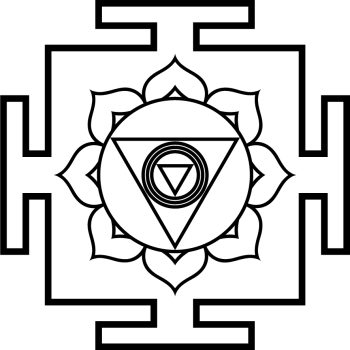
YANTRA The Great Divine Powers Chinnamasta
Iconographic representation
It has a terrible representation, but it expresses its exceptional power of transformation.
It is a metaphor for the release of attachments, which are the source of any suffering, but also a representation of our true inner nature, the natural state, ourselves, completely detached and happy.
The central element of her symbolic representation is her “headless” appearance, which suggests her ability to transcend mental fluctuations, access the mental void, and access the ultimate state—of nondual freedom and happiness.
This involves giving up identification with the ego and relating to the Self. It means giving up identification with our limited being, with desires, with fleeting personality.
Although it seems that the renunciation of the head is associated with the renunciation of thinking, nevertheless, in the tantric tradition this hypostasis is understood as the highest form of spiritual authority.
It means total liberation from identification with the ego, which brings true freedom and knowledge, perfect purity, and nondual happiness that does not depend on anything from the outside—divine bliss or divine ecstasy.
For this reason she appears represented as happy.
Because of her purity she is also called pure Yogini, Vajra Yogini, Dakini supreme or Para Dakini.
The moment when we transcend our limits, our attachments, can be a frightening one:
This is because the ego has the impression that it is in danger of disappearing completely, that it is in the moment of its extinction.
However, the ego is a very important and useful tool with which we interact with the outside world.
That is why it is important:
- not to identify with the ego, but to use it as a precious tool
- to constantly pursue identification with the Supreme Self Atman, which is infinite, immortal and immutable.
The blood he drinks symbolizes suffering, pain, but also joys and everything that has to do with the limited, ephemeral nature of man.
By drinking it, it suggests the sublimation of the suffering generated by attachment into freedom, detachment and non-dual happiness.
All the elements that surround it and those with which it is adorned create a terrifying frame.
She wears a garland of skulls and a necklace of bones around her neck. It has a snake tied around its neck like a yajnopavita or a sacred thread.
The sky is full of lightning.
All these are representations of human suffering and limitations that she overcomes, and for this reason she appears to be happy.
The place where the event takes place is a cremation ground.
This place draws our attention to the ephemeral nature of life and the importance of the spiritual effort to evolve permanently.
In his right hand he holds his own head, and on the left a sword.
- The cut head is a symbol of liberation from any limitation and attachments.
- The sword signifies discernment ( viveka ), the ability to discern between illusion and truth.
- Radiant eyes are symbols of the ability to know directly the supreme truth.
- Her lightning-shaped hair suggests the ability for very rapid transformation.
- The language symbolizes the colossal power of the divine logos, or efficiency in working with the mantra.
On both sides are present two other goddesses, whose names are Dakini and Varini. these are related to kundalini’s ascension on Ida or Pingala, instead of Sushumna.
Chinnamasta dances over the bodies of Kama, the god of love and his wife Rati.
In other representations, Krishna and Radha are in their places.
This iconographic representation of Chinnamasta in the Hindu tradition is practically identical to that of the great goddess Vajra Dakini in the tradition of Tibetan Buddhism.
The couple of gods who are at her feet symbolizes the union of the male and female energies of the human psyche.
In fact, there are three streams of blood coming out of Chinnamasta’s throat:
- a central flow that she herself drinks
- and two others placed on the left and right side of this central flow, signifying the subtle energies from ida nadi and pingala nadi, and which are drunk by the two goddesses Dakini and Varini.